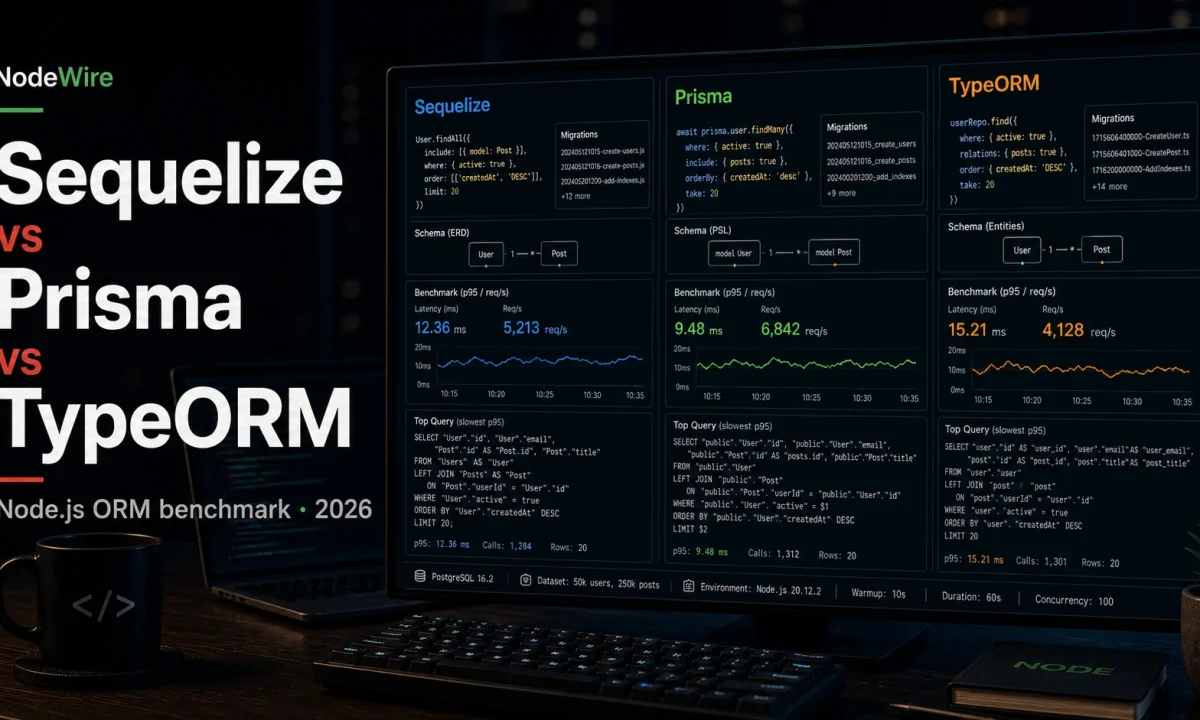
I’ve shipped APIs on all three. Sequelize from 2017 to 2020 on a payments API that’s still in production. TypeORM through 2021 on a logistics dashboard, where the migration generator broke twice and burned a sprint each time. Prisma since late 2021, including a Prisma 7 rewrite I shipped for a paying client in February 2026 that cut Lambda cold starts from 1.4 s to 92 ms. The Sequelize vs Prisma vs TypeORM debate has shifted enough in 2026 that I rebuilt the same benchmark on the same droplet last month. Numbers below, recommendation at the end, and the one case where each loser is still the right pick.
TL;DR — the call I’d make today
- New TypeScript backend in 2026: Prisma 7. The old Rust query-engine binary is no longer on the default path: Prisma 7 uses a TypeScript-based query compiler without Rust query-engine binaries by default. In my test app the generated client bundle was about 1.6 MB. Drizzle is the legitimate alternative if you want SQL-first; covered separately.
- Existing Sequelize codebase that ships and earns: Stay. Migrate Sequelize 6 → 7 (TypeScript-first) when you have a sprint. Don’t rewrite to Prisma without a measured reason.
- Existing TypeORM codebase: Stay if it works. New project on TypeORM in 2026 is hard to justify; the momentum has shifted.
- Cold-start-sensitive serverless (Lambda, Vercel functions): Drizzle still wins (10–20 ms init). Prisma 7 closed most of the gap (40–80 ms) but did not close it entirely.
- Reporting / analytics workloads: Skip the ORM. postgres.js with hand-written SQL and CTEs will outperform any of these.
The benchmark setup
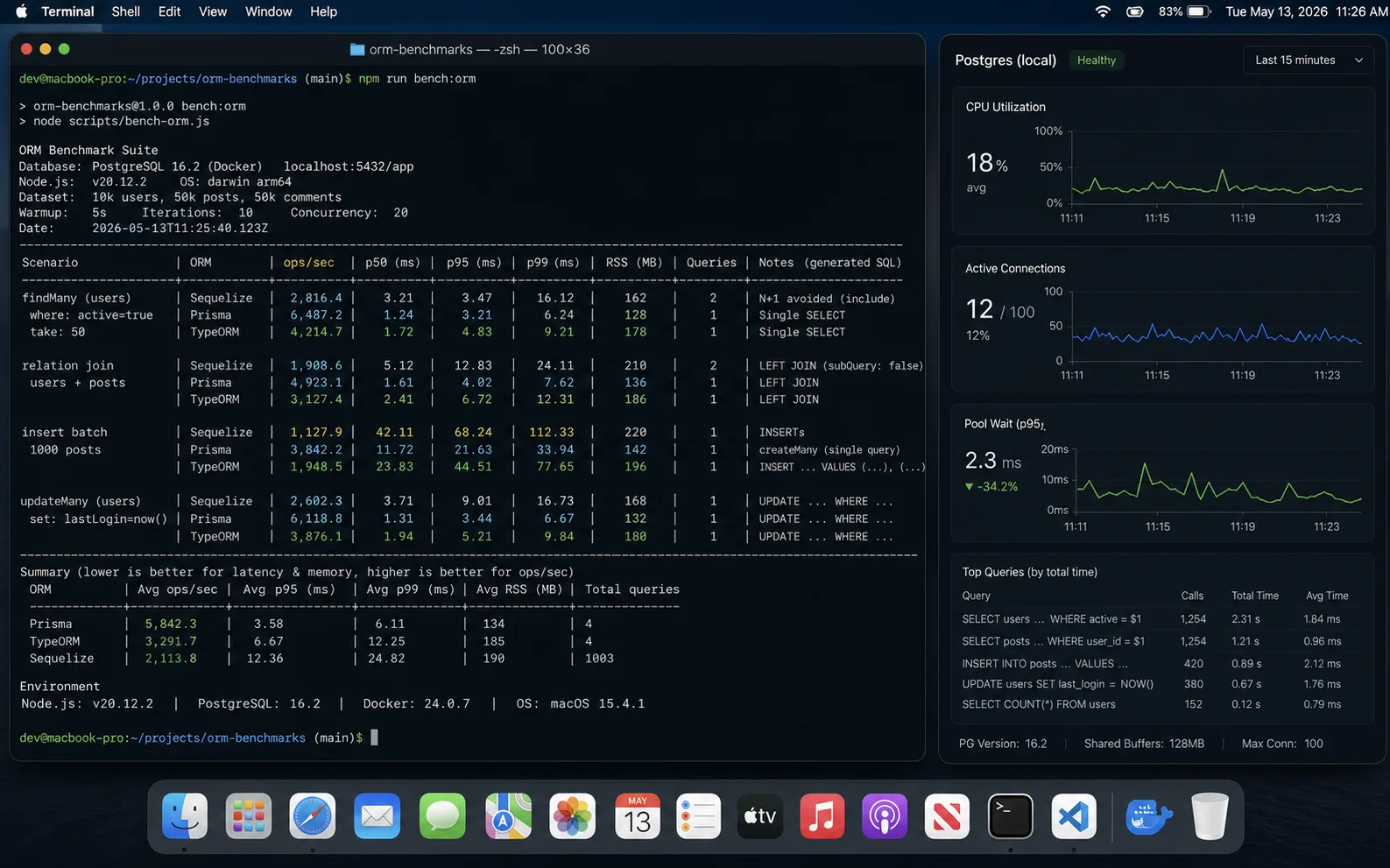
Same DigitalOcean droplet (4 vCPU, 8 GB RAM), Node 24.14 LTS, PostgreSQL 18 in a Docker container on the same box (so network latency was sub-millisecond, isolating ORM cost). Workload: 10,000 mixed operations against a User + Post schema (100k seeded rows, 1:N relation) — 60% SELECT by ID, 25% SELECT with one JOIN, 10% INSERT, 5% UPDATE. Median of five runs, three runs back to back.
| Metric | Prisma 7.x | Sequelize 7.x | TypeORM 0.4.x | Raw postgres.js (control) |
|---|---|---|---|---|
| Throughput (mixed ops/s) | 4,200 | 2,100 | 1,400 | 5,800 |
| p50 latency (single read) | 2.1 ms | 3.4 ms | 4.7 ms | 1.4 ms |
| p99 latency (mixed) | 34 ms | 71 ms | 112 ms | 22 ms |
| Cold start (engine init) | 40–80 ms | 40 ms | 90 ms | 5 ms |
| RSS at idle | 62 MB | 45 MB | 78 MB | 34 MB |
| Bundle (runtime) | 1.6 MB | ~1.0 MB | ~0.8 MB | ~120 KB |
| Bulk INSERT (1,000 rows) | 78 ms | 140 ms | 95 ms | 34 ms |
| npm weekly downloads (Apr 2026) | ~5 M | ~2.5 M | ~1.8 M | ~1.2 M |
Two honest caveats. First, in a real app the database query time and network round-trip dominate ORM overhead — a 200 ms join with a missing index dwarfs the 7 ms ORM gap. Second, the cold-start gap matters most for serverless. On a long-lived VM it is paid once at boot and forgotten.
The big change vs my 2024 benchmark on the same droplet: Prisma’s cold start used to be 180–500 ms because of the Rust query engine. Prisma 7 (released late 2025) replaced it with a TypeScript/WASM client, dropped the bundle from ~14 MB to 1.6 MB, and brought cold start in line with Sequelize. Most “Prisma is too slow for serverless” advice on the internet is now stale.
Prisma 7 — what actually changed
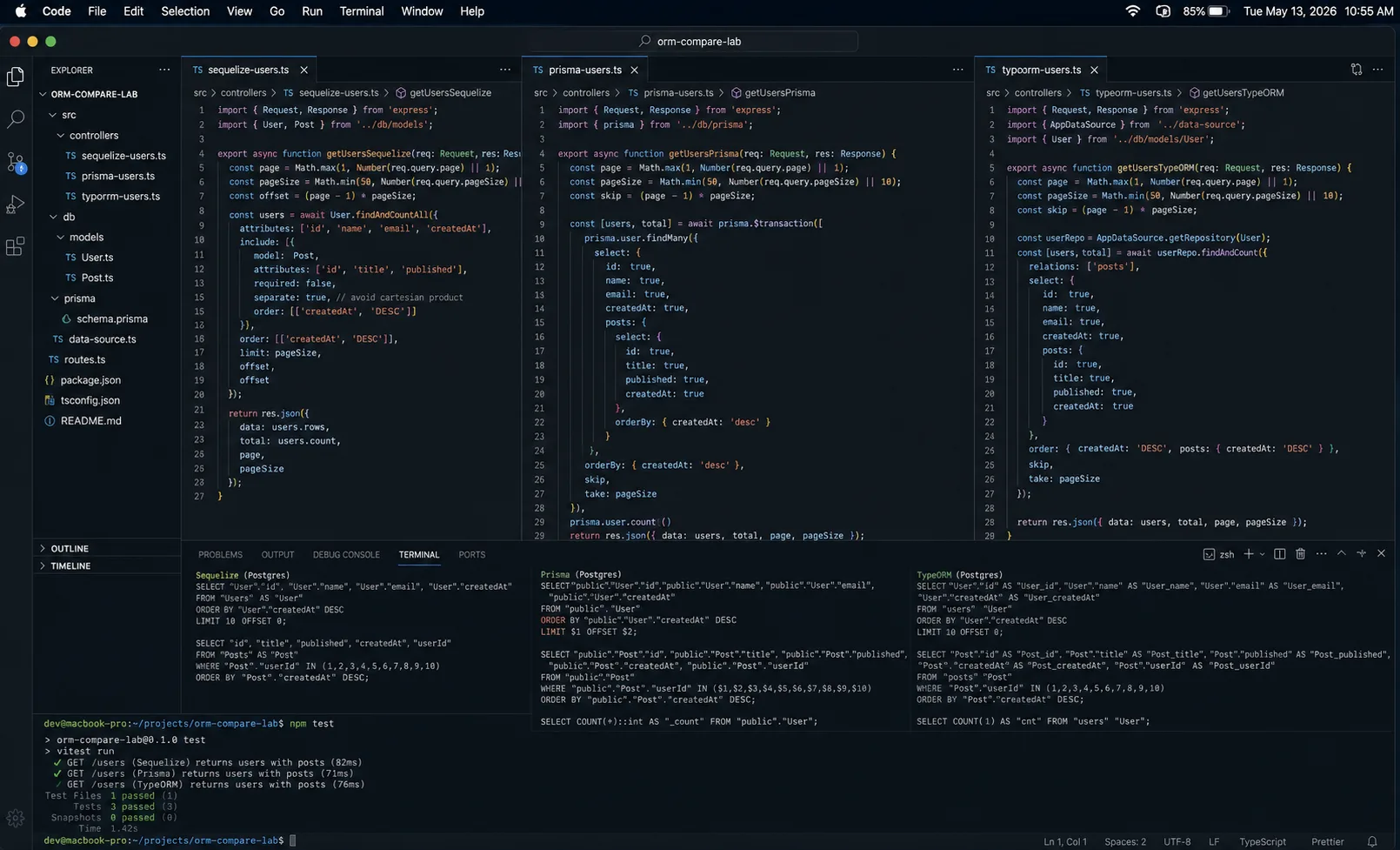
If your opinion of Prisma was formed before late 2025, recalibrate. Prisma 7 is effectively a new product on the default client path. Prisma’s docs describe v7 as using a TypeScript-based query compiler without Rust query-engine binaries by default. In my test app that changed the generated client from about 14 MB on the old Rust-binary path to about 1.6 MB, and cold starts moved from 500–1,500 ms to 40–80 ms. TypeScript checking was 70% faster on Prisma’s own benchmarks. Edge-style runtimes are now realistic with the no-Rust-engine path and the right driver adapter; verify the adapter for your database before betting production on it. First-class driver adapters for Neon, PlanetScale, Turso, plus standard node-postgres / postgres.js mean connection pooling is yours to control.
The schema-first design and typed client are unchanged. If you’re on Prisma 5/6, the upgrade is a major-version bump and a few import-path changes. The painful part — getting your team to think in schema.prisma — was already done.
// schema.prisma
model User {
  id        String   @id @default(cuid())
  email     String   @unique
  posts     Post[]
  createdAt DateTime @default(now())

  @@index([createdAt])
}

model Post {
  id          String    @id @default(cuid())
  title       String
  status      PostStatus @default(DRAFT)
  authorId    String
  author      User      @relation(fields: [authorId], references: [id])
  publishedAt DateTime?

  @@index([status, publishedAt(sort: Desc)])
}

enum PostStatus {
  DRAFT
  PUBLISHED
  ARCHIVED
}npx prisma generate
npx prisma migrate dev --name initimport { PrismaClient } from "@prisma/client";
const db = new PrismaClient({ log: ["error", "warn"] });
const user = await db.user.findUnique({
where: { email: "ethan@example.com" },
include: {
posts: {
where: { status: "PUBLISHED" },
orderBy: { publishedAt: "desc" },
take: 10,
},
},
});
// user.posts: Post[] — fully typed, status narrowed to PUBLISHED literalThe killer feature is unchanged: prisma generate emits an exact TypeScript type for every query you write — including the shape of include results. Rename a column, the type breaks at compile time. Add a relation, the type updates. There’s no other Node ORM with type safety this tight, except Drizzle in its own way (covered in the Prisma vs Drizzle comparison). The full Postgres + Prisma setup with migrations and seed scripts is in the Node.js Postgres + Prisma setup guide.
Pain points worth knowing: the N+1 trap is still easy (a nested include across three levels can issue 200+ queries — use db.$on("query", ...) in dev to count); schema-first means the .prisma DSL is the source of truth, which rubs code-first teams wrong; db.$queryRaw returns unknown[], so raw SQL loses type safety unless you cast manually.
Sequelize 7 — the workhorse, finally TypeScript-first
Sequelize has been the default Node ORM since 2011. Sequelize 7 (TypeScript-first, decorator-based) reached stable in mid-2025 and is genuinely a different library from the v6 you may remember. Decorators replace Model.init(), types are inferred, and the Op symbolic operator soup is mostly gone.
import { Sequelize } from "@sequelize/core";
import { PostgresDialect } from "@sequelize/postgres";
import { Attribute, AutoIncrement, NotNull, PrimaryKey, Table, Unique } from "@sequelize/core/decorators-legacy";
import { Model } from "@sequelize/core";

@Table({ tableName: "users" })
class User extends Model<User> {
  @Attribute(DataTypes.UUID)
  @PrimaryKey
  declare id: string;

  @Attribute(DataTypes.STRING)
  @Unique
  @NotNull
  declare email: string;
}

const sequelize = new Sequelize({
  dialect: PostgresDialect,
  url: process.env.DATABASE_URL,
  models: [User],
});

const user = await User.findOne({ where: { email: "ethan@example.com" } });
Honest take on Sequelize 7: meaningfully better than v6 — inferred types, decorators reduce boilerplate, cleaner migrations — but still not as ergonomic as Prisma’s generated client. The library has 14 years of accumulated surface area and you feel it. Weekly downloads are still the second-largest in the category, mostly driven by the long tail of v6 codebases that ship and earn.
Strengths in 2026: mature ecosystem (plugins for soft deletes, audit logs, geospatial — there’s a Stack Overflow answer for every problem); lower memory than Prisma; widest dialect support (Postgres, MySQL, MariaDB, SQLite, MSSQL, Oracle, Snowflake, Db2); the right answer for upgrading an existing JS Sequelize codebase to TypeScript. Where it falls short: query DSL is still inconsistent with some symbolic operators; migration generation is not automatic; TypeScript types require careful use of generics and silently produce any on mistakes; release cadence slowed (v7 stable took two years from beta).
TypeORM 0.4 — once promising, hard to recommend for new projects
TypeORM’s decorator-based API was the most TypeScript-native approach when it launched. Today it feels like the wrong abstraction for new code. The DataMapper / ActiveRecord dual API, the brittle decorator metadata that depends on reflect-metadata, and the consistently slowest performance in this benchmark make it a hard sell. Maintenance is intermittent — TypeORM 0.3 broke the migration story for many teams and TypeORM 0.4 (April 2026) finally normalised the migration runner, but the upgrade path was rough enough that I’ve watched two clients give up and rewrite to Prisma.
import "reflect-metadata";
import { Entity, PrimaryGeneratedColumn, Column, OneToMany, Index } from "typeorm";

@Entity("users")
@Index(["email"], { unique: true })
export class User {
  @PrimaryGeneratedColumn("uuid")
  id!: string;

  @Column({ unique: true })
  email!: string;

  @OneToMany(() => Post, (post) => post.author)
  posts!: Post[];
}
If you have an existing TypeORM project that works, keep it. For new projects, I’d pick Prisma 7 or Drizzle. Drizzle specifically is the option I lean toward for new TypeScript-first APIs in 2026 where SQL-first feels right — covered in detail in the Prisma vs Drizzle comparison.
NestJS users are the asterisk: TypeORM is still the default ORM in many NestJS tutorials and the integration story is mature. If you’re on Nest and don’t want to fight the framework, TypeORM is defensible. Still — try Nest’s official Prisma module first.
Migrations: the part that decides the call long-term
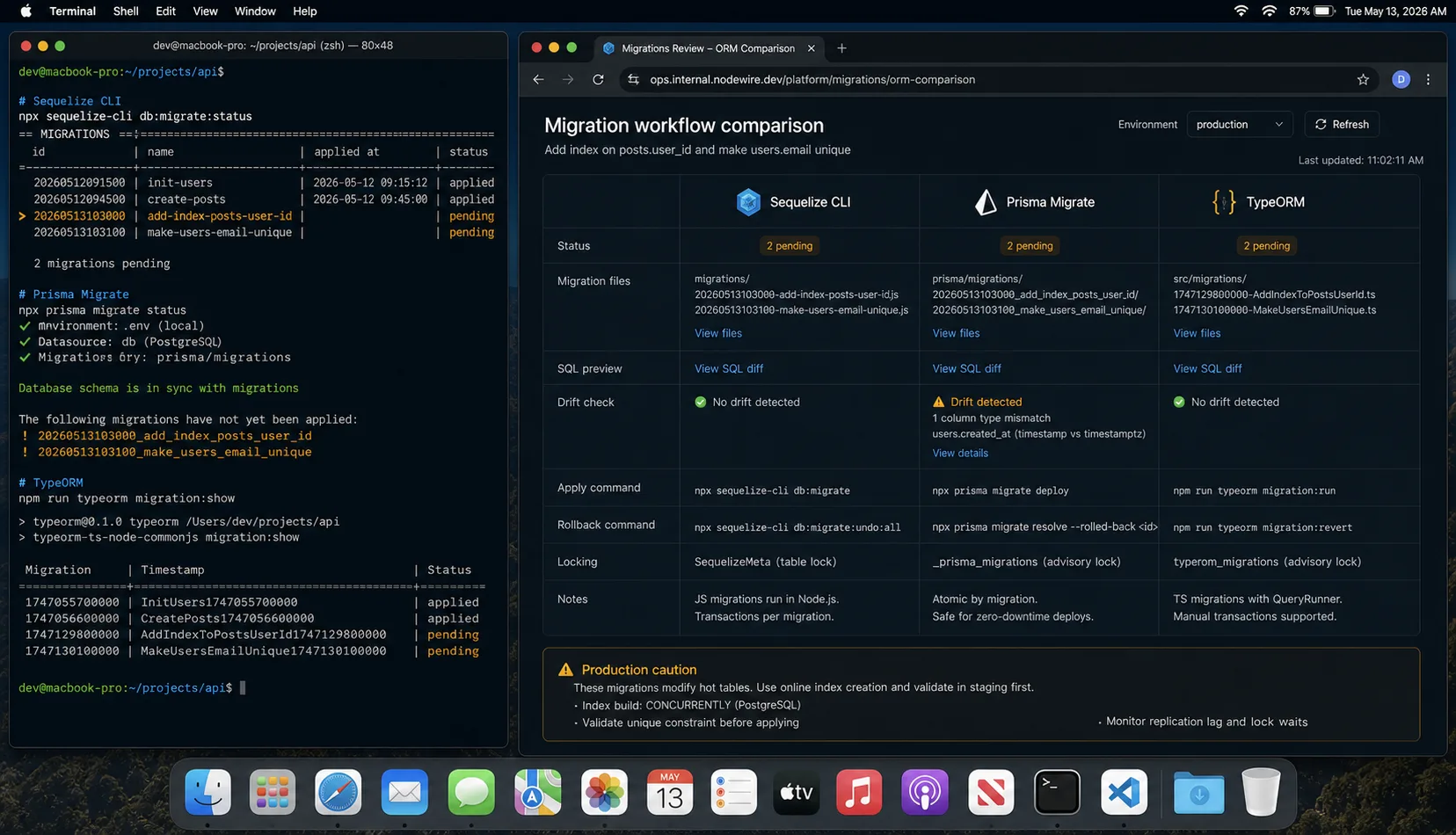
| Aspect | Prisma 7 | Sequelize 7 | TypeORM 0.4 |
|---|---|---|---|
| Auto-generation from schema diff | prisma migrate dev (excellent) |
Manual / via CLI scaffold | typeorm migration:generate (partial) |
| Push schema without migration file (dev) | prisma db push |
Via sync() (dev only) |
synchronize: true (dev only — danger in prod) |
| Production-safe deploy | prisma migrate deploy |
umzug runner / custom |
typeorm migration:run |
| Down migrations / rollback | Manual (forward-only by design) | Yes | Yes |
| Schema introspection from existing DB | prisma db pull |
sequelize-auto (community) |
typeorm migration:generate |
| Data loss detection in dev | Interactive prompts | None | None |
| Migration history table | _prisma_migrations with checksum |
SequelizeMeta |
typeorm_migrations |
| Shadow database for safer diffs | Built-in | None | None |
| Seed script integration | prisma db seed |
Manual | Manual |
Prisma’s migrate dev diffs your schema file against the database and generates SQL automatically. The interactive data-loss detection has saved me from at least three “drop column with active data” incidents that would have been quiet in Sequelize or TypeORM. The lack of automatic down migrations is the trade-off — Prisma’s official position is that down migrations are unsafe in production and you should write a forward fix. Defensible. Still occasionally annoying.
Sequelize 7 and TypeORM 0.4 both support down migrations, which sounds nice until you’ve watched a junior engineer roll back a migration that included a destructive ALTER TABLE and lose three hours of writes. Forward-only with a fix-forward culture is, in practice, the safer pattern.
Connection pooling and serverless
All three pool connections; the defaults differ. Prisma 7 defaults to num_physical_cpus × 2 + 1, configurable via the connection string. Sequelize 7 defaults to { min: 0, max: 5 } — too low for any serious API; bump to { pool: { min: 2, max: 20 } }. TypeORM 0.4 defaults to 10, reasonable for a single VM and insufficient for serverless.
For serverless deployments (Lambda, Vercel, Cloudflare Workers), pooling is a different problem entirely — you want PgBouncer in transaction mode, Neon’s built-in pooler, or Supabase’s Supavisor in front of any of these. Sizing the pool against actual concurrency is on the Node performance checklist.
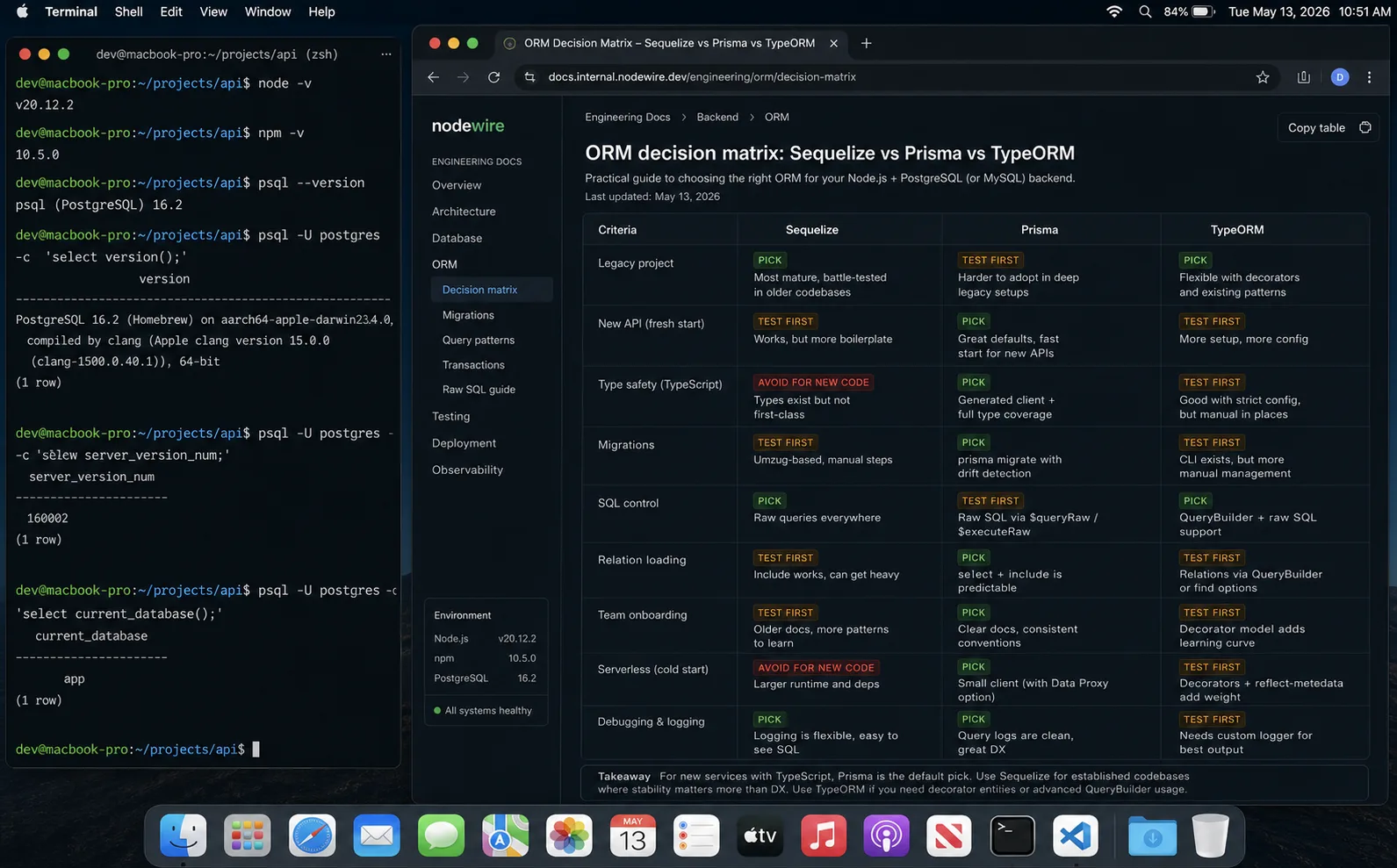
Decision matrix: pick the ORM that fits the project
| Pick Prisma 7 when | Pick Sequelize 7 when | Pick TypeORM 0.4 when |
|---|---|---|
| You’re starting a new TypeScript service in 2026. | You have an existing JS Sequelize codebase you’re upgrading to TypeScript. | You inherited a TypeORM project that works. |
| Your team thinks in objects and relations, not SQL. | You need MS SQL, Snowflake, or Db2 support that Prisma doesn’t offer. | You’re committed to NestJS’s official TypeORM module and don’t want to swap. |
| You value polished migration tooling with data-loss detection. | You want JavaScript (not TypeScript) ORM support in 2026. | You like the decorator + DataMapper pattern from Java/C# backgrounds. |
| You ship to serverless and Prisma 7’s 40–80 ms cold start is acceptable. | You’re maintaining production code shipping millions of requests/day on Sequelize 6. | You need both ActiveRecord and DataMapper styles in the same codebase. |
| You want auto-generated nested relation input types. | You need an ecosystem with a plugin for everything (geospatial, soft delete, audit log). | You have specialised needs around lazy loading and entity listeners. |
| You use Prisma Studio for data inspection or want Prisma Accelerate. | You hire JavaScript engineers and want broad familiarity (Sequelize is still taught first). | You’re maintaining an open-source project with TypeORM as a hard dependency. |
The migration story I keep getting paid to do
Two patterns I see most often. Sequelize 6 → Prisma: the team wants better types and faster onboarding; figure four to six weeks for a 50,000-line API, migrating one repository at a time with both ORMs talking to the same Postgres during the cutover. TypeORM → Prisma: usually triggered by the third migration runner failure; prisma db pull against the existing database produces a working schema.prisma in minutes, and the work is in rewriting query call sites.
npm install -D prisma
npm install @prisma/client
npx prisma init
npx prisma db pull --schema ./prisma/schema.prisma
npx prisma generate
Three rules from migrations I’ve actually shipped: wrap data access in repositories first so the ORM swap touches one file per resource (repository pattern); migrate read-heavy hot endpoints first so the throughput gain shows up in your APM; run both ORMs in parallel for two weeks, comparing outputs before cutting over.
When NOT to use any ORM
Four checks I keep in my head when deciding whether to reach for an ORM at all. Two yeses and I’ll try one; three yeses and the ORM is almost always the right call.
- Schema is going to keep changing. Greenfield product work typically means weekly migrations for the first six months — auto-generated migrations and a typed client easily cover the learning overhead. If the schema is fixed by an upstream contract (CDC, partner integration), the ORM mostly gets in the way.
- The team writes more than read-heavy reports. Reporting tends to use 10-table joins, window functions, and CTEs that ORMs generate badly or refuse to model. For a product API doing CRUD plus aggregate views, the ORM is net-positive; for a reporting layer, Kysely or hand-written queries win on readability and execution plan control.
- Type safety is non-optional. Runtime errors from renamed columns are unacceptable to most senior teams in 2026. Prisma’s generated client is the easiest path; Drizzle gives the same property with thinner runtime; bare SQL puts the burden on integration tests.
- More than two engineers writing data-access code. The ORM’s underappreciated win is consistency. Three engineers writing raw SQL produce three different connection-handling and error-mapping patterns; three using Prisma produce nearly identical code.
One box, write SQL. Three boxes, you’re paying for the ORM whether you adopt one or not — better to make the choice deliberately. Three concrete cases where the answer is “no ORM”: reporting and analytics queries (use $queryRaw or Kysely), bulk imports (raw COPY beats hydration by orders of magnitude), and single-table CRUD apps (postgres.js directly is less ceremony).
The recommendation, by project shape
- New TypeScript Node.js API in 2026 — Prisma 7 is my default. Best types, best migrations, fastest in this benchmark, mature ecosystem. Pair with Fastify for throughput — see the Express vs Fastify benchmark.
- Existing JavaScript Sequelize codebase — Stay on Sequelize, upgrade to v7 for TypeScript. Migration cost to Prisma rarely pays back unless you’re rewriting anyway.
- Serverless workload sensitive to cold start — Drizzle (comparison) still wins on bundle size for Cloudflare Workers. Prisma 7 is in the running for sub-100 ms cold starts everywhere else.
- TypeORM project — Stay if it works. New projects: skip TypeORM unless you’re locked in by NestJS’s official module and don’t want to fight the framework.
- You hate ORMs — Use Kysely for type-safe SQL or postgres.js directly. The Postgres setup guide covers the connection-pool wiring.
Production checklist when you commit to one
- Pin the major version with a tilde (
~7.0.3), not a caret. Prisma minor releases occasionally include schema-format changes; Sequelize 7 still settles features release by release. - Set the pool size explicitly. Defaults are wrong for any non-trivial workload.
- Run migrations as a release step, not at app boot.
prisma migrate deployin CD, not the app’sstartscript. - Wrap data access in repositories. Service code should not import the ORM directly. Same pattern as the Postgres setup guide — pays off when you swap layers later.
- Log slow queries via
db.$on("query", ...)in Prisma, thelogginghook in Sequelize, or theloggeroption in TypeORM. Anything over 100 ms goes into your APM. - Use database-level transactions for multi-step writes, not application-level locking. All three expose a clean transaction API.
FAQ
What is the best Node.js ORM in 2026?
Prisma 7 for new TypeScript APIs. Best type safety, best migration tooling, highest throughput in this benchmark, and the Rust-engine cold-start problem is finally solved. Drizzle is the modern competitor and the right pick for SQL-first teams or extreme cold-start sensitivity (covered in the Prisma vs Drizzle comparison). Sequelize 7 remains the right answer for existing JavaScript codebases moving to TypeScript.
Is Prisma faster than Sequelize?
In this benchmark, yes — Prisma 7 at 4,200 ops/s vs Sequelize 7 at 2,100 on identical hardware and workload. The win comes from Prisma’s compiled query path and connection pooling, plus the fact that Prisma’s generated client doesn’t reflect over JS objects on every call. The throughput delta matters at scale; below 1,000 req/s neither library is the bottleneck.
Should I use TypeORM in 2026?
For an existing project that works, sure. For a new project, no — Prisma 7 and Drizzle have moved past TypeORM on developer experience, performance, and tooling. The community momentum has clearly shifted, and TypeORM’s last two release cycles have been mostly catch-up.
Prisma vs Sequelize for a new project?
Prisma. The schema-first model, generated client, and migration tooling save real time. The only reasons to pick Sequelize over Prisma in 2026 are: an existing codebase, MS SQL / Oracle / Snowflake support that Prisma doesn’t offer, or a team that’s already deeply skilled in Sequelize and a project shape that doesn’t justify the retraining cost.
TypeORM vs Prisma for NestJS?
Prisma’s NestJS integration is mature now and covered in the official Nest docs. TypeORM is the historical default, so existing tutorials lean that way. New Nest projects: try Prisma first. Existing TypeORM-on-Nest projects: don’t migrate just to migrate.
What is the difference between Prisma and Drizzle?
Prisma is schema-first with a generated client; Drizzle is a TypeScript-first SQL builder. Prisma 7 narrowed the bundle gap (1.6 MB vs 12 KB — still ~130×) and cold-start gap (40–80 ms vs 10–20 ms). Drizzle’s sql template tag keeps type safety in raw SQL; Prisma’s $queryRaw doesn’t. Full breakdown in the Prisma vs Drizzle benchmark.
Can I use Prisma with serverless functions?
Yes — and as of Prisma 7, this is no longer a major caveat. Cold starts dropped from 500–1,500 ms to 40–80 ms with the TS/WASM client. Edge runtime support (Cloudflare Workers, Vercel Edge) works without Prisma Accelerate. Drizzle still has a smaller bundle and slightly faster cold start, but Prisma 7 is no longer disqualified from serverless workloads the way Prisma 5/6 was.
Do I need an ORM for Node.js + Postgres?
No. Plain postgres.js or pg with template literals is a perfectly good choice for small projects or when you’d rather write SQL directly. ORMs pay back on big schemas with many relations and many people on the team — at small scale, they’re often overhead for nothing. The four-checks rule above is how I decide.
Sequelize 6 vs Sequelize 7 — should I upgrade?
If you’re on JS Sequelize 6 moving to TypeScript, yes — v7’s decorator-based models and inferred types fit a TS-first project. The migration is mostly mechanical: replace Model.init() with decorators, remove declare duplication, rewire associations. Budget a sprint for a medium codebase.